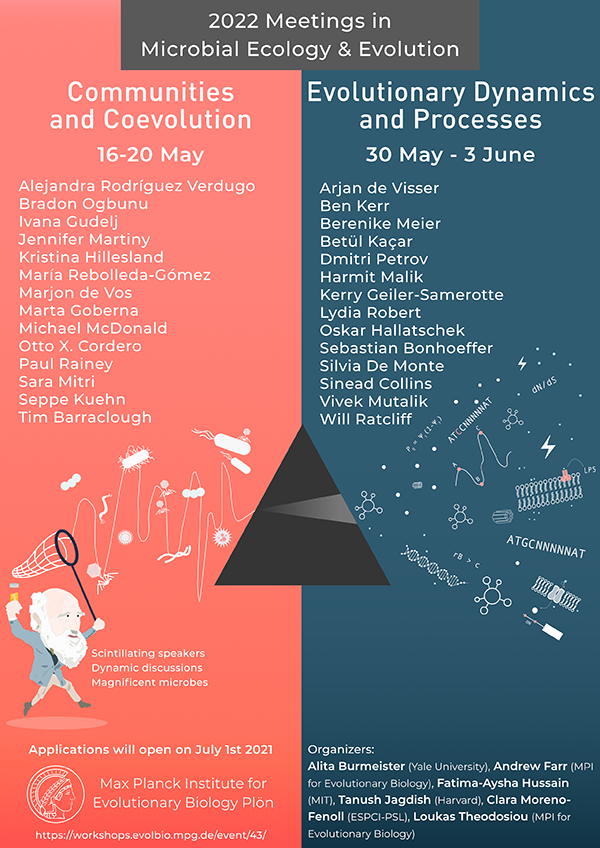
-
Luis Valentin (University of California Berkeley)
Discharging deeply-sourced groundwater can contain reduced inorganic sulfur compounds that sustain chemoautotrophic ecosystems, yet questions remain regarding the role of CPR bacteria within these complex subsurface communities. Here, we studied two sites where microbial biofilms grow in cold, sulfide-rich groundwater derived from deep crustal and meteoric sources. Profiling of biofilms and...
Go to contribution page -
Gisela Tatianna Rodriguez Sanchez
Gisela T. Rodriguez1,4, Barbara Huber1,3, 4, Alejandra Melfo2, Luis D. Llambi3 and Kristin Saltonstall4 1Laboratorio de Microbiología Molecular y Biotecnología, Universidad de los Andes, Mérida, Venezuela. 2Centro de Física Fundamental, Universidad de Los Andes, Mérida, Venezuela. 3Instituto de Ciencias Ambientales y Ecológicas, Universidad de Los Andes, Mérida, Venezuela. 4Smithsonian...
Go to contribution page -
Nittay Meroz (The Hebrew University of Jerusalem)
Managing and engineering microbial communities relies on the ability to predict their composition. While progress has been made on predicting compositions on short, ecological timescales, there is still little work aimed at predicting compositions on evolutionary timescales. Therefore, it is still unknown for how long communities typically remain stable after reaching ecological equilibrium,...
Go to contribution page -
Marie Rescan (Catalan Institute for Water Research )
City sewers shelter rich and diverse bacterial communities that are continuously exposed to antibiotic residues from human excreta, thus becoming a reservoir of resistance. Predicting the risk of antibiotic resistance evolution in city sewers thus requires a comprehensive understanding of the dynamics and evolution of wastewater bacterial communities. However, interactions between species...
Go to contribution page -
Michael Raatz (MPI for Evolutionary Biology)
Microbial communities comprise an astonishing diversity. Decomposing these often complex communities into small community modules holds the promise to elucidate the mechanisms behind the assembly and maintenance of this diversity. Among these, the apparent competition module, where two prey types compete and are preyed on by a shared predator, has received particular attention, often with a...
Go to contribution page -
Miguel Díez Fernández de Bobadilla (IRYCIS (Ramón y Cajal Institute for Health Research) )
Hospital-built environments, and especially Intensive Care Units (ICUs), are hotspots for the emergence, transmission, and evolution of antimicrobial resistance (AMR). Most bacterial species able to acquire genes encoding resistance to antibiotics (ARGs), heavy metals (MRGs) or biocides (BcRGs) are colonizing opportunistic pathogens able to survive in abiotic systems (surfaces, medical...
Go to contribution page -
Luis Zaman (University of Michigan )
Most of Earth's diversity has been produced in rounds of adaptive radiation, but the ecological drivers of diversification, such as abiotic complexity (i.e., ecological opportunity) or predation and parasitism (i.e., ecological necessity), are hard to disentangle. However, most of these radiations occurred hundreds of thousands if not millions of years ago, and the mechanisms promoting...
Go to contribution page -
José Carlos Ramón Hernández Beltrán (Max-Planck Institute for Evolutionary Biology )
The study of evolution has traditionally focused on the effects of selection on individuals. In recent years, attention has turned to the possibility of selection on communities. Yet much remains to be understood about the conditions necessary for selection to work on collectives. Previous theoretical works have shown that communities can evolve as units of selection provided that the...
Go to contribution page -
52. Experimental (co)evolution in a multi‐species microbial community results in local maladaptationMeaghan Castledine (University of Exeter )
Interspecific coevolutionary interactions can result in rapid biotic adaptation, but most studies have focused only on species pairs. Here, we (co)evolved five microbial species in replicate polycultures and monocultures for 10 weeks (~100 generations) and quantified local adaptation. Specifically, growth rate assays were used to determine adaptations of each species’ populations to (1) the...
Go to contribution page -
Maxime Ardre (ESPCI )
Colonization of a pristine environment by bacterial communities is a crucial step for the co-evolutionnary dynamics followed by bacteria, in the wild as well as in laboratories. A key phase for the fixation of a strain in a new environment is the primary phase of growth: the lag phase- where cells adapt to their new conditions. For a population composed of several settlers, an essential...
Go to contribution page -
Pauline Buffard (MPI for Evolutionary Biology)
Recent work from our lab showed that it is possible to use selfish genetic elements (SGEs) to link genes to community function. My project uses this same experimental approach and applies it to understand how horizontal gene transfer (HGT) might affect the establishment of the microbiome of the well-studied nematode Caenorhabditis elegans. To achieve this, I am experimentally evolving C....
Go to contribution page -
Nanami Kubota (University of Pittsburgh )
Bacteriophage integrated in bacterial chromosomes (prophages) can act as mobile genetic elements, making them important drivers of rapid bacterial evolution. The Pf phages are filamentous Inoviruses that are integrated in most Pseudomonas aeruginosa genomes and they are unusual because they can reproduce without lysing their host. Pf prophage particles have been shown to contribute to P....
Go to contribution page -
Akos Kovacs (Technical University of Denmark )
Synthetic communities provide a proxy to reveal the ecological interaction between microbes, including metabolic cross feeding and inter-species signals that influence growth and differentiation. Among these laboratory communities, biofilm retains a spatially organized niche. We have recently demonstrated how metabolic interaction between Bacilli and Pseudomonads in biofilms is translated to...
Go to contribution page -
Sijmen Schoustra (Wageningen University)
Microbial ecosystems generally consist of communities with a complex composition. Prolonged propagation in a new environment may impose various selective pressures that can change species composition. Over the short term, ecological processes such as species sorting may be most prominent. Over the longer term, novel mutations in specific players of the community may add to the shaping of...
Go to contribution page -
Peter Deines (CAU Kiel, GEOMAR)
Organisms and their resident microbial communities form a complex and mostly stable ecosystem. Of particular relevance are the factors that shape the stability and resilience of such communities, despite different fitness trajectories of the microbiome members. Our work addresses microbial interactions within the microbiome of the simple metaorganism, Hydra. Firstly, we ask whether the...
Go to contribution page -
Brendan Bohannan (University of Oregon/CAU-Kiel )
-
Sebastien Wielgoss (ETH Zurich)
Among group-forming microbes, the predatory myxobacteria represent important model organisms in developmental biology and social evolution. Many important aspects of their multicellular life cycles have been studied in great molecular detail. We recently showed that individuals of the myxobacterium Myxococcus xanthus stay together as kin groups over extended periods of time in soil, thereby...
Go to contribution page -
Sebastian Gude (Technical University of Denmark (DTU) )
Bacteria require a diverse set of metabolites to proliferate. While some bacteria fulfil their metabolic needs through de novo biosynthesis, others rely on uptake. Mechanisms enabling stable metabolite provisioning among free-living bacteria, i.e., in the absence of means for positive assortment, remain largely unclear. Particularly, since the production of ‘public goods’ bares the inherent...
Go to contribution page -
Chih-Fu Yeh (Stanford University )
Ecological theory suggests spatial synchrony in population fluctuation can be generated via three mechanisms: (1) dispersal between populations; (2) environmental forcing, known as the Moran effect; and (3) biotic interactions with synchronized or mobile species. Although both experimental and theoretical works have been conducted to examine the relative importance of these mechanisms,...
Go to contribution page -
Siobhan O'Brien (Trinity College Dublin )
Slowing the spread of antimicrobial resistance is urgent if we are to continue treating infectious diseases successfully. There is increasing evidence microbial interactions between and within species are significant drivers of resistance. On one hand, cross-protection by resistant genotypes can shelter susceptible microbes from the adverse effects of antibiotics, reducing the advantage of...
Go to contribution page -
James Hall (Department of Evolution, Ecology and Behaviour, University of Liverpool )
Mobile genetic elements (MGEs) are integral members of microbial communities, interacting with cellular microbes as well as other mobile genetic elements (MGEs), and affecting the dynamics and evolution of cells, populations, and microbiomes. Conjugative plasmids are MGEs that can transfer themselves between bacteria, forming a major route for the transmission of diverse adaptive traits in...
Go to contribution page -
Yansong Zhao
Yansong Zhao1, Andrew D. Farr1 & Paul B. Rainey1,2 1 Department of Microbial Population Biology, Max Planck Institute for Evolutionary Biology, Plön, Germany. 2 Laboratory of Biophysics and Evolution, ESPCI, Paris, France.
Microbial communities have intrinsic complexity in their composition, totality of interaction and function, which has been an inspiration for scientific curiosity and, at...
Go to contribution page
Choose timezone
Your profile timezone: