-
Sonam Kulkarni (Institute of Avian Research 'Vogelwarte Helgoland' )
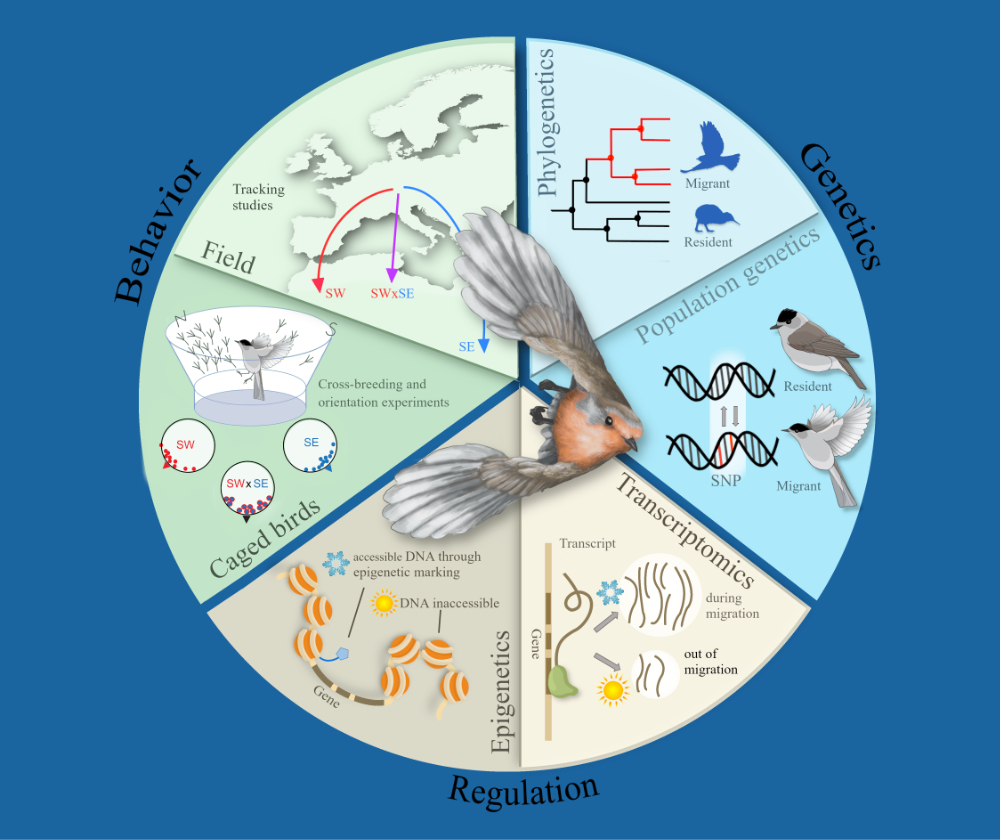
This poster aims to summarize the current body of research on the genetic regulatory mechanisms of migration in songbirds and provide potential future directions to study migration, with a strong emphasis on transcriptomics and using scRNAseq. The poster also illustrates the differences in RNA expression in different retinal cell types of 2 migratory songbirds- the Eurasian Blackcap and the...
Go to contribution page -
Loïc Lesobre (RENECO INTERNATIONAL WILDLIFE CONSULTANTS LLC )
The Asian houbara bustard (Chlamydotis macqueenii), a partial migrant species of conservation concern, offers a compelling model for unravelling the evolutionary dynamics of avian migration. Intensive radiotracking records revealed both resident and migrant populations (including obligatory and partially migrant individuals), each following distinct migratory pathways. To investigate the...
Go to contribution page -
Yassine Kasmi (Thünen Institute of Fisheries Ecology, Bremerhaven)
Ute Postel, Yassine Kasmi, Reinhold Hanel
The European smelt, Osmerus eperlanus, is a facultative anadromous species that colonizes diverse aquatic ecosystems in northern Europe. Its life cycle involves a freshwater phase for spawning and larval development, often followed by a growth and maturation phase in the sea. Lacustrine resident populations are known from several lakes in northern...
Go to contribution page -
Robert Ethan Rollins (Institute of Avian Research "Vogelwarte Helgoland")
Robert Ethan Rollins, Helena Westerdahl, Miriam Liedvogel
Variation in migratory phenotype could play an important role in shaping the evolutionary history of bird species. Through choice of breeding and overwintering grounds, birds could face a variable environment especially in relation to pathogen or parasite structure which would result in changes to functionality of immunity. This...
Go to contribution page -
Guido Roberto Gallo (University of Milan)
Guido Roberto Gallo1, Riccardo Rossi1, Simona Secomandi2, Diego Rubolini3, Roberto Ambrosini3, Andrea Bonisoli-Alquati4, Giulio Formenti5, Luca Gianfranceschi1
The barn swallow (Hirundo rustica) is a long-distance migratory songbird with six described subspecies breeding in Europe, Asia, North America and North Africa. The subspecies differ in body size, ventral coloration, length of tail...
Go to contribution page -
Jesper Emanuel Andersson (Lund University)
Differences in migratory behaviour has long been suggested to potentially drive speciation, but the genetics underlying this process remains a mystery. Studies of migratory divides have played a crucial role for our understanding of how such differences can lead to reproductive isolation. Movements of hybrid zone clines can indicate either population change or selection acting on the loci...
Go to contribution page -
Toby Doyle (University of Exeter)
Toby Doyle, Jaimie Barnes, Oliver Poole, Toby Baril, William Hawkes, Eva Jimenes Guri, Karl Wotton
Migration is a widely observed phenomenon found across many lineages with the ability to undergo long-distance movement is underpinned by various morphological, physiological and behavioural traits, the genetic basis of which are poorly understood. Recently, we have unpacked the genetic...
Go to contribution page -
Joan Ferrer Obiol (University of Milan)
Joan Ferrer Obiol, Marie Claire Gatt, Marcella Sozzoni, Don-Jean Léandri-Breton, Shannon Whelan, Josephine R. Paris, Scott A. Hatch, Chinatsu Nakajima, Giulio Formenti, Luca Gianfranceschi, Andrea Pilastro, Jacopo G. Cecere, Akiko Shoji, Kyle H. Elliot, Diego Rubolini
Migration is a widespread response of birds to seasonal environmental changes. Climate change is affecting bird migration in...
Go to contribution page -
Jan von Rönn (Swiss Ornithological Institute)
Migratory divides are contact zones where individuals with divergent migration behaviour meet and potentially interbreed. We tracked barn swallows (Hirundo rustica) within and on either side of a migratory divide in Northern Germany, Switzerland and Finland to study various consequences and correlates of divergent migration routes and non-breeding areas. Furthermore, capitalizing on the...
Go to contribution page -
Pablo Salmon (Institute of Avian Research "Vogelwarte Helgoland")
Salmón P., Weissensteiner, M., Rodríguez, M., Wikelski, M., Partecke, J., & Liedvogel M.
Telomeres are repetitive, noncoding DNA sequences that cap and protect the ends of chromosomes and they constitute a highly conserved system involved in the maintenance of genome stability and replication. Over the last two decades the question on how telomere length is related to survival and fitness...
Go to contribution page -
Georg Manthey (Institute of avian research )
Georg Manthey, Miriam Liedvogel
Go to contribution page
As was shown in countless experiments, young migratory songbirds can find their way over hundreds of kilometers without guidance of their parents or other conspecifics, showing that there is a genetic basis to migratory direction. Behavioural experiments on Eurasian blackcaps have suggested that migratory direction is inherited following mendellian rules,... -
Sarah Döge (Carl von Ossietzky University Oldenburg )
Sara Döge, Corinna Langebrake, Lars Burnus, Miriam Liedvogel
With the focus on variability of songbird migration, we try to understand which factors influence this behaviour. Breeding site fidelity seems to be essential for the evolution of migration, as it’s an important strategy to return to a successful breeding area to persist in seasonally changing habitats. We investigated the...
Go to contribution page
Choose timezone
Your profile timezone: