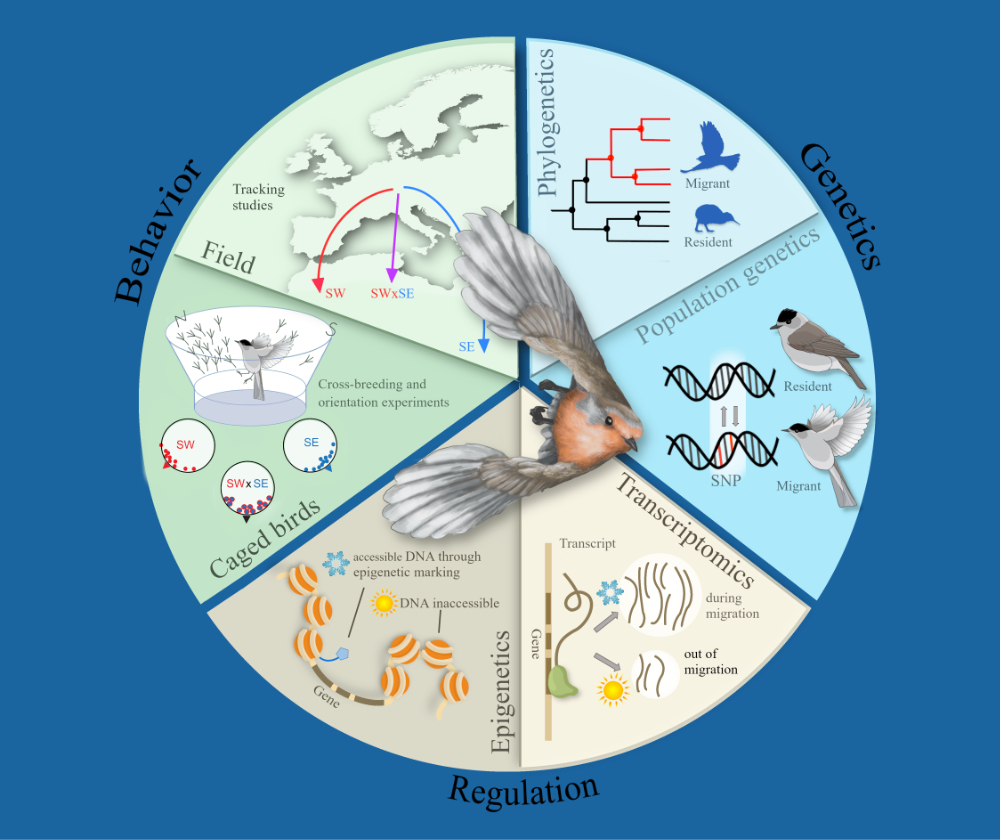
-
Miriam Liedvogel (Institute of Avian research)11/03/2024, 15:00
-
Kristina Brauburger (Lund University)11/03/2024, 15:15
The Bogong moth is an iconic Australian insect species of significant cultural and ecological relevance and also a remarkable nocturnal migrator. Each spring freshly emerged Bogong moths escape the deadly high temperatures in their breeding grounds in southern Queensland and north-western New South Wales by embarking on a 1000 km journey to locate specific, cool, ridge-top caves in the...
Go to contribution page -
11/03/2024, 16:00
-
Koosje Lamers (University of Groningen)12/03/2024, 09:30
Migrant birds have species- and population-specific routes linking their distant breeding and wintering grounds. They often show migratory connectivity: birds are not only more similarly timed as others from the same breeding population, but also winter closer together. Yet, it is unknown what determines these shared wintering sites, whilst they are vital to understand migrants’ adaptive...
Go to contribution page -
Marius Roesti12/03/2024, 10:15
Marius Roesti, Nicole Nesvadba, Thor Veen, Keila Stark, Jeffrey Groh, Daniel Bolnick, Yoel Stuart, Catherine L. Peichel
Adaptive population divergence is commonly ascribed to selection favoring different individuals in different habitats. In this case, random migration between habitats, and hence gene flow between populations, should counteract adaptive divergence. Yet, population...
Go to contribution page -
Staffan Bensch (Lund University)12/03/2024, 10:35
Staffan Bensch
Go to contribution page
Migration propensity in birds is evolutionary labile, with many examples of within-species migratoriness increasing or decreasing on the time scale of modern ornithology. In contrast, shifts in migration routes to more nearby wintering grounds seem to be a much slower process, resulting in what has been called “suboptimal migration routes”. We examined the evolutionary history... -
Gillian Durieux (Doctoral Researcher)12/03/2024, 11:30
The avian migratory phenotype is both spectacular and complex, encompassing a range of morphological, physiological, and behavioural traits such as pre-migratory fat storage, circannual rhythms, and sensory mechanisms for navigation. Many of these traits have a strong genetic basis, however the identity of the molecular mechanisms that underpin the migratory phenotype is still unknown. To...
Go to contribution page -
Jun Ishigohoka (MPI for Evolutionary Biology)12/03/2024, 12:20
Avian migration is an ecologically and evolutionarily important behaviour. Classic breeding experiments show that the difference in migratory propensity between migrant and resident populations has genetic bases. More recent population genomic studies indicate that differential selection on gene regulation instead of protein variants may be responsible for this heritable behavioural variation....
Go to contribution page -
Ines Sanchez-Donoso (Doñana Biological Station (CSIC-EBD) )12/03/2024, 12:40
How multitrait phenotypic polymorphisms that are geographically structured can be mantained in a highly mobile and panmictic species is difficult to explain. However, that is what we observe in the common quail (Coturnix coturnix), a small migratory galliform that moves widely during the breeding season following ephemeral habitats, in search of sequential matings and with successive clutches...
Go to contribution page -
Kazuhiro Wada12/03/2024, 17:15
Species-specific behaviors evolve through changes in gene expression among species and the resulting effects on physiological and anatomical alterations in associated neural circuits. However, the neural and genetic mechanisms underlying species-specific learned behaviors remain unclear. Songbirds acquire species-specific songs through vocal learning by a neural circuit known as the song...
Go to contribution page -
Jane M. Reid (Norwegian University of Science and Technology, NTNU)13/03/2024, 09:30
Understanding and predicting micro-evolutionary dynamics of seasonal migration in the face of rapid environmental changes requires quantifying the relative magnitudes of genetic and environmental effects underlying facultative expression of migration, and of migratory plasticity. Foundational work in migration genetics invoked the quantitative genetic paradigm, envisaging that overall genetic...
Go to contribution page -
Andrea Flack (Max Planck Institute of Animal Behavior )13/03/2024, 10:15
How the migratory behaviour of birds develops over their lifetime is a longstanding question with important implications for predicting the adaptive capacity of migrants in a changing world. However, our inability to follow the movements of individuals from early life has limited our understanding of the ontogeny of migration. My research examines the development of migratory behaviour in...
Go to contribution page -
Barbara Helm (Swiss Ornithological Institute ), Tianhao Zhao (University of Groningen)13/03/2024, 10:35
Tianhao Zhao, Yuri Anisimov, Wieland Heim, Guoming Zhang, Wenjia Chen, Zongzhuang Liu, Xiaolu Jiao, Depin Li, Magnus Hellström, Staffan Bensch, Gang Song, Fumin Lei, Miriam Liedvogel, Kristen Ruegg, Bregje Wertheim, Barbara Helm
Go to contribution page
The global distribution of geographical barriers is often associated with differentiation of global avian flyways. Selection pressure from the presence of... -
Teresa Pegan (University of Michigan)13/03/2024, 11:30
Seasonal migration is both a movement behavior and a substantial investment of time and energy into overwinter survival. Migration therefore potentially affects the evolutionarily consequential processes of dispersal (movements between breeding sites) and life history allocation (the trade-off between survival and reproduction). I examined evolutionary consequences of seasonal migration by...
Go to contribution page -
Matthias Weissensteiner (Institute of Avian Research)13/03/2024, 12:15
Matthias H. Weissensteiner, Kira Delmore, Juan Sebastian Lugo Ramos, Gregoire Arnaud, Julio Blas, Bruno Faivre, Paolo Franchini, Ivan Pokrovsky, Martin Wikelski, Jesko Partecke, Miriam Liedvogel
Partial migration describes the phenomenon of one population of a species containing both migratory and sedentary individuals and it has been suggested that this type of behavior is genetically...
Go to contribution page -
Corinna Langebrake (Institute of Avian Research "Vogelwarte Helgoland" )13/03/2024, 12:35
Corinna Langebrake, Javier Pérez-Tris, Juan Carlos Illera, Georg Manthey, Miriam Liedvogel
Bird migration evolved as an adaptation to seasonally changing habitats. Migratory behaviour can vary within the same species in case of partial migratory behaviour, i.e. one population (or individual) is migratory and another one is resident. Species that exhibit a wide variety of migratory...
Go to contribution page -
Karl Wotton (University of Exeter ), Toby Doyle (University of Exeter )14/03/2024, 09:30
Toby Doyle & Karl Wotton
Migration is a widely observed phenomenon with long-distance movements supported by morphological, physiological and behavioural traits, of which the genetic bases of are poorly understood. While these traits vary with season, they can also vary between sexes due to different life-history requirements. Recently we have unpacked the genetic components underpinning...
Go to contribution page -
19. Enhanced flight performance following repeated bouts of flight and recovery in an insect migrantOliver Poole (University of Exeter)14/03/2024, 09:50
Oliver Poole, Karl Wotton
The regulation of muscle tissue is crucial for migration as it directly impacts the efficiency and success of long-distance movement. Migratory birds increase muscle mass prior to migration with subsequent muscle catabolism thought to be important for maintaining optimal power to weight ratios as fuel is used up and as an endogenous source of water and Kreb cycle...
Go to contribution page -
Jaimie Barnes (University of Exeter)14/03/2024, 10:10
Jaimie Barnes, Karl Wotton, Chris Bass
Animal migrations worldwide are changing in response to human activities and migratory insects have been subject to the same drastic declines seen in many resident species. Long-distance movement can expose migrants to a diverse range of habitats, and migratory demands may reduce the function of physiological processes not directly linked to migration,...
Go to contribution page -
Daria Shipilina (Uppsala University)14/03/2024, 10:30
Butterfly migration is an enchanting yet complex natural phenomenon. However, to date, detailed knowledge about its genetic basis is limited to a few model organisms. The painted lady butterfly, Vanessa cardui, stands out for its remarkably long-distance migrations and virtually cosmopolitan distribution and has become an emerging model species for research on migratory behavior. Here we...
Go to contribution page -
Nora Bergman (University of Helsinki )14/03/2024, 11:15
Bergman, N., Lehikoinen, P., Kluen, E., Procházka, P., Stokke, B., Lo Cascio Sætre C., Eroukhmanoff, F., Thorogood, R., Rönkä, K.
Go to contribution page
Many species are currently undergoing range shifts to track their environmental niche with climate change. However, colonizing new areas can also cause changes in the shifting population. Repeated founder events are expected to erode genetic variation and reduce... -
Chao-min Xu (Nanjing Agricultural University)14/03/2024, 11:35
Chao-min Xu, Meng-yu Hu, Yu-meng Wang, Gao Hu*
Migration is a behavioral strategy that allows insects to respond to seasonal changes in resources and the environment. Insect migration is regulated by external environmental factors such as nutrient conditions, temperature and humidity, photoperiod, and population density, as well as by intrinsic factors. Photoperiod, an important feature of...
Go to contribution page -
Christoph Meier (Swiss ornithological institute)14/03/2024, 11:55
Christoph M. Meier, Guilia Masoero, Gwenaël Jacob, Hakan Karaardıç, Raül Aymí, Strahil G. Peev, Pierre Bize
How readily birds can adapt their migration strategy to a changing environment is a longstanding inquiry in ornithology. It is firmly established that crucial behaviours, such as migration direction and departure date, are genetically hardwired. However, certain aspects, like the...
Go to contribution page -
Joe Wynn (Institute for Avian Research )14/03/2024, 12:15
Joe Wynn, Robert Rollins, Jochen Dierschke, Staffan Bensch, Darren Irwin and Miriam Liedvogel
Vagrancy - the tendency of (migratory) animals to leave their known range - is an essential yet poorly understood component of migratory route evolution. Vagrant birds are, by definition, extremely uncommon, and hence conventional tracking technologies are not practical since vagrant individuals...
Go to contribution page -
Miriam Liedvogel (Institute for Avian Research)14/03/2024, 12:35
-
Sonam Kulkarni (Institute of Avian Research 'Vogelwarte Helgoland' )
This poster aims to summarize the current body of research on the genetic regulatory mechanisms of migration in songbirds and provide potential future directions to study migration, with a strong emphasis on transcriptomics and using scRNAseq. The poster also illustrates the differences in RNA expression in different retinal cell types of 2 migratory songbirds- the Eurasian Blackcap and the...
Go to contribution page -
Loïc Lesobre (RENECO INTERNATIONAL WILDLIFE CONSULTANTS LLC )
The Asian houbara bustard (Chlamydotis macqueenii), a partial migrant species of conservation concern, offers a compelling model for unravelling the evolutionary dynamics of avian migration. Intensive radiotracking records revealed both resident and migrant populations (including obligatory and partially migrant individuals), each following distinct migratory pathways. To investigate the...
Go to contribution page -
Yassine Kasmi (Thünen Institute of Fisheries Ecology, Bremerhaven)
Ute Postel, Yassine Kasmi, Reinhold Hanel
The European smelt, Osmerus eperlanus, is a facultative anadromous species that colonizes diverse aquatic ecosystems in northern Europe. Its life cycle involves a freshwater phase for spawning and larval development, often followed by a growth and maturation phase in the sea. Lacustrine resident populations are known from several lakes in northern...
Go to contribution page -
Robert Ethan Rollins (Institute of Avian Research "Vogelwarte Helgoland")
Robert Ethan Rollins, Helena Westerdahl, Miriam Liedvogel
Variation in migratory phenotype could play an important role in shaping the evolutionary history of bird species. Through choice of breeding and overwintering grounds, birds could face a variable environment especially in relation to pathogen or parasite structure which would result in changes to functionality of immunity. This...
Go to contribution page -
Guido Roberto Gallo (University of Milan)
Guido Roberto Gallo1, Riccardo Rossi1, Simona Secomandi2, Diego Rubolini3, Roberto Ambrosini3, Andrea Bonisoli-Alquati4, Giulio Formenti5, Luca Gianfranceschi1
The barn swallow (Hirundo rustica) is a long-distance migratory songbird with six described subspecies breeding in Europe, Asia, North America and North Africa. The subspecies differ in body size, ventral coloration, length of tail...
Go to contribution page -
Jesper Emanuel Andersson (Lund University)
Differences in migratory behaviour has long been suggested to potentially drive speciation, but the genetics underlying this process remains a mystery. Studies of migratory divides have played a crucial role for our understanding of how such differences can lead to reproductive isolation. Movements of hybrid zone clines can indicate either population change or selection acting on the loci...
Go to contribution page -
Toby Doyle (University of Exeter)
Toby Doyle, Jaimie Barnes, Oliver Poole, Toby Baril, William Hawkes, Eva Jimenes Guri, Karl Wotton
Migration is a widely observed phenomenon found across many lineages with the ability to undergo long-distance movement is underpinned by various morphological, physiological and behavioural traits, the genetic basis of which are poorly understood. Recently, we have unpacked the genetic...
Go to contribution page -
Joan Ferrer Obiol (University of Milan)
Joan Ferrer Obiol, Marie Claire Gatt, Marcella Sozzoni, Don-Jean Léandri-Breton, Shannon Whelan, Josephine R. Paris, Scott A. Hatch, Chinatsu Nakajima, Giulio Formenti, Luca Gianfranceschi, Andrea Pilastro, Jacopo G. Cecere, Akiko Shoji, Kyle H. Elliot, Diego Rubolini
Migration is a widespread response of birds to seasonal environmental changes. Climate change is affecting bird migration in...
Go to contribution page -
Jan von Rönn (Swiss Ornithological Institute)
Migratory divides are contact zones where individuals with divergent migration behaviour meet and potentially interbreed. We tracked barn swallows (Hirundo rustica) within and on either side of a migratory divide in Northern Germany, Switzerland and Finland to study various consequences and correlates of divergent migration routes and non-breeding areas. Furthermore, capitalizing on the...
Go to contribution page -
Pablo Salmon (Institute of Avian Research "Vogelwarte Helgoland")
Salmón P., Weissensteiner, M., Rodríguez, M., Wikelski, M., Partecke, J., & Liedvogel M.
Telomeres are repetitive, noncoding DNA sequences that cap and protect the ends of chromosomes and they constitute a highly conserved system involved in the maintenance of genome stability and replication. Over the last two decades the question on how telomere length is related to survival and fitness...
Go to contribution page -
Georg Manthey (Institute of avian research )
Georg Manthey, Miriam Liedvogel
Go to contribution page
As was shown in countless experiments, young migratory songbirds can find their way over hundreds of kilometers without guidance of their parents or other conspecifics, showing that there is a genetic basis to migratory direction. Behavioural experiments on Eurasian blackcaps have suggested that migratory direction is inherited following mendellian rules,... -
Sarah Döge (Carl von Ossietzky University Oldenburg )
Sara Döge, Corinna Langebrake, Lars Burnus, Miriam Liedvogel
With the focus on variability of songbird migration, we try to understand which factors influence this behaviour. Breeding site fidelity seems to be essential for the evolution of migration, as it’s an important strategy to return to a successful breeding area to persist in seasonally changing habitats. We investigated the...
Go to contribution page
Choose timezone
Your profile timezone: