-
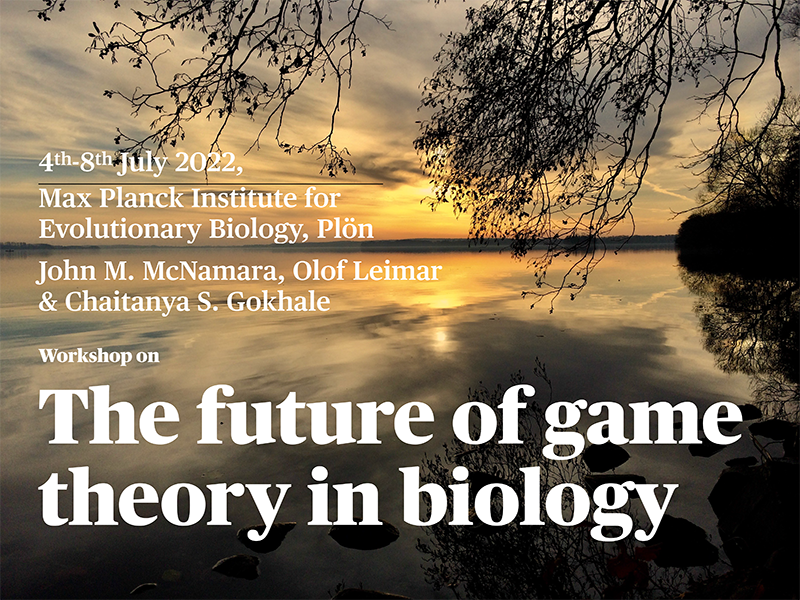
Chaitanya Gokhale (MPI for Evolutionary Biology)04/07/2022, 19:00
Overview of the programme and workshop format
Go to contribution page -
Sigrunn Eliassen (University of Bergen)05/07/2022, 09:00
Classical game theory has trained our intuition about important aspect of social interactions, making it possible to recognize general structures of games played out in complex natural settings. Moving beyond the basic models, we appreciate that games are dynamic in nature, cost and benefits are inherently linked to local interactions, and animal responses are based on previous experiences and...
Go to contribution page -
Willem Frankenhuis (Utrecht University)05/07/2022, 09:45
There is well-established theory exploring the conditions in which phenotypic plasticity is favoured by natural selection over non-plastic development. However, most of this work has assumed a two-stage life history: organisms sample a cue, or they don’t sample, relying instead on inherited information; and then develop a phenotype, either instantaneously or after a time lag. Recent modeling...
Go to contribution page -
Yoh Iwasa (Kyushu University)05/07/2022, 16:00
I will speak basically on two topics.
[1] Coupled social and ecological dynamics:
Go to contribution page
I will discuss the issue of replicator dynamics versus best response dynamics. First I will speak two models related to illegall logging in tropical forests. One model discusses the action of profit sharing by the Indonesian government, which was effective in suppressing illegal logging of teak forests. In... -
Christian Hilbe (Max Planck Institute for Evolutionary Biology)06/07/2022, 09:00
The study of cooperation is one of the landmark applications of evolutionary game theory. The respective literature explores why individuals may cooperate even when there are strong incentives to defect. In a broader sense, this literature also explores related questions, such as how social norms evolve over time, or why human behavior is subject to certain quirks (such as: why do we value...
Go to contribution page -
Nichola Raihani (University College London)06/07/2022, 09:45
Humans are outstanding in their ability to cooperate with unrelated individuals, and punishment – paying a cost to harm others – is thought to be a key supporting mechanism. According to this view, cooperators punish defectors, who respond by behaving more cooperatively in future interactions. However, evidence from laboratory and real-world settings casts serious doubts on the assumption that...
Go to contribution page -
Hans Metz (Leiden University)06/07/2022, 16:00
Adaptive dynamics (AD) is the natural biological embedding for evolutionary game theory. It looks how continuous traits, think e.g. of the frequency of playing hawk, develop over evolutionary time through subsequent mutant substitutions. This dynamic embedding allows to bring to bear various tools of dynamical systems theory, think e.g. of the development of a bifurcation theory for ESSes. In...
Go to contribution page -
Peter Hammerstein (Humboldt University Berlin)07/07/2022, 09:00
Since its origin, evolutionary game theory has dealt with syndromes of behavioral and morphological traits in phenotypic models of adaptive evolution. Sneaky male mating
Go to contribution page
strategies, for example, require both the lack of masculine ornamentation and special behaviors to avoid fighting with dominant males. Due to an almost obsessive focus on mixed
strategy equilibria, many early attempts to... -
Franjo Weissing (University of Groningen)07/07/2022, 09:45
No two individuals are alike. Even individuals of the same sex, age, size and social background tend to differ consistently in temperament, motivation, cognition and behaviour. In virtually all species studied, ranging from spiders to sticklebacks and from octopuses to chimpanzees, individuals differ systematically in whole suites of correlated behaviours. For example, one often finds stable...
Go to contribution page -
Jens Krause (IGB Berlin)08/07/2022, 09:00
Collective signals which are used to attract mates, defend territories or deter predators have been observed in different species ranging from social insects, over fire-flies to fish and birds. In this talk I will show an example of fish schools which collectively produce waves that delay attacks by bird predators and reduce their success probability. Different mechanisms which result in such...
Go to contribution page -
08/07/2022, 13:30
Choose timezone
Your profile timezone: