-
Kristina Brauburger (Lund University)11/03/2024, 15:15
The Bogong moth is an iconic Australian insect species of significant cultural and ecological relevance and also a remarkable nocturnal migrator. Each spring freshly emerged Bogong moths escape the deadly high temperatures in their breeding grounds in southern Queensland and north-western New South Wales by embarking on a 1000 km journey to locate specific, cool, ridge-top caves in the...
Go to contribution page -
Koosje Lamers (University of Groningen)12/03/2024, 09:30
Migrant birds have species- and population-specific routes linking their distant breeding and wintering grounds. They often show migratory connectivity: birds are not only more similarly timed as others from the same breeding population, but also winter closer together. Yet, it is unknown what determines these shared wintering sites, whilst they are vital to understand migrants’ adaptive...
Go to contribution page -
Gillian Durieux (Doctoral Researcher)12/03/2024, 11:30
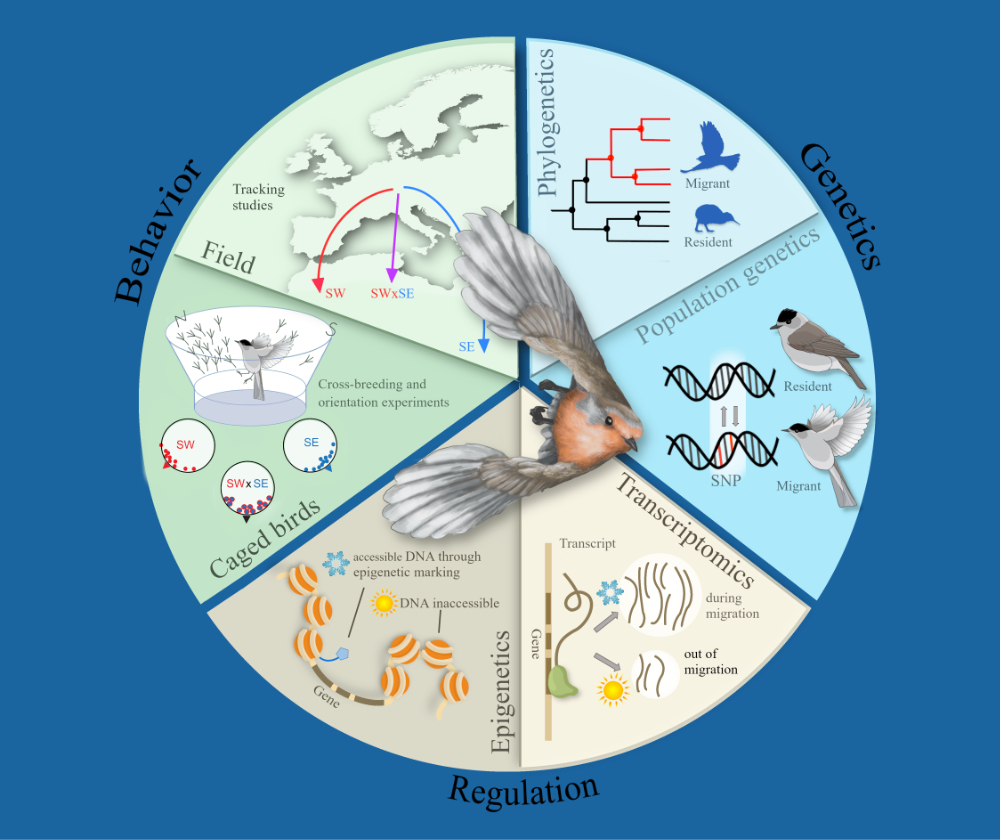
The avian migratory phenotype is both spectacular and complex, encompassing a range of morphological, physiological, and behavioural traits such as pre-migratory fat storage, circannual rhythms, and sensory mechanisms for navigation. Many of these traits have a strong genetic basis, however the identity of the molecular mechanisms that underpin the migratory phenotype is still unknown. To...
Go to contribution page -
Kazuhiro Wada12/03/2024, 17:15
Species-specific behaviors evolve through changes in gene expression among species and the resulting effects on physiological and anatomical alterations in associated neural circuits. However, the neural and genetic mechanisms underlying species-specific learned behaviors remain unclear. Songbirds acquire species-specific songs through vocal learning by a neural circuit known as the song...
Go to contribution page -
Jane M. Reid (Norwegian University of Science and Technology, NTNU)13/03/2024, 09:30
Understanding and predicting micro-evolutionary dynamics of seasonal migration in the face of rapid environmental changes requires quantifying the relative magnitudes of genetic and environmental effects underlying facultative expression of migration, and of migratory plasticity. Foundational work in migration genetics invoked the quantitative genetic paradigm, envisaging that overall genetic...
Go to contribution page -
Teresa Pegan (University of Michigan)13/03/2024, 11:30
Seasonal migration is both a movement behavior and a substantial investment of time and energy into overwinter survival. Migration therefore potentially affects the evolutionarily consequential processes of dispersal (movements between breeding sites) and life history allocation (the trade-off between survival and reproduction). I examined evolutionary consequences of seasonal migration by...
Go to contribution page -
Daria Shipilina (Uppsala University)14/03/2024, 10:30
Butterfly migration is an enchanting yet complex natural phenomenon. However, to date, detailed knowledge about its genetic basis is limited to a few model organisms. The painted lady butterfly, Vanessa cardui, stands out for its remarkably long-distance migrations and virtually cosmopolitan distribution and has become an emerging model species for research on migratory behavior. Here we...
Go to contribution page
Choose timezone
Your profile timezone: